

Hyperscaler Exit Strategy: Calculating the ROI of Moving from AWS / Azure to Local Malaysian Private Cloud
Hyperscaler exit strategy outlines how your organization can transition workloads, applications, and data from public cloud environments to alternative infrastructure. You do not need to abandon cloud computing completely. This strategy is about placing each workload where it makes the most sense financially, operationally, and strategically.
A “hyperscaler” refers to cloud computing platforms operated by large-scale providers. For example, Amazon Web Services (AWS), Google Cloud Platform, Microsoft Azure, Alibaba Cloud, Oracle Cloud Infrastructure and others.
Why Establish Hyperscaler Exit Strategy Now?
The Cloud First honeymoon period of the early 2020s has given way to a more sophisticated Cloud Smart era. The scalability of global hyperscalers has brought a hard realization for Chief Financial Officers (CFO) in Malaysia. The hyperscaler “hidden tax”. Therefore, calculating the ROI of moving from AWS, Azure, and others to local Malaysian Private Cloud is essential.
Why Cloud Repatriation is Trending?
Interoperability, availability and cloud-related operational expenditure are among the serious concerns IT departments face as they battle with the Cloud Hangover. They do not want to end up in a position where their new technology infrastructure ends up being harder to manage and costing more than initially planned.
While the benefits of cloud computing are substantial, it is essential for businesses to plan for a potential exit from public cloud services. In some sectors, particularly those regulated or associated with government, it is becoming mandatory to have a formal Hyperscaler Exit Strategy or Cloud Exit Plan, prior to the adoption of new cloud services.

As cloud usage expanded, the reality became more complicated.
The question now isn’t whether to use the cloud, but how to design a data pipeline architecture that keeps its benefits while regaining control over cost, performance, and compliance.
You are not choosing between clouds. You’re choosing between margins.
Although hyperscalers provide a fast track to deployment, they also bring financial and legal complexities that affect businesses. Some of the factors include:
- Unpredictable Consumption: Hyperscalers provide innovation velocity but sacrifice financial predictability. They enable rapid deployment, global scale, and speed but also come with billing complexity. While intended to offer flexibility, the unpredictable nature of consumption can lead to financial strain.
- Cost Dynamics That Don’t Scale: Services that run continuously like database servers, application backends, storage-intensive workloads don’t benefit from pay-as-you-go models. You are paying premium rates for elasticity that you may never use.
- The Egress Trap: As traffic increases daily, data transfer costs grow proportionally. Hyperscalers make it costly to access data within Malaysia, with a cost ranging from $0.05 to $0.12 per GB for data egress. Turning what seemed like affordable storage into expensive retrieval.
- National Strategy: The Malaysian government has invested RM2 billion in Sovereign AI Cloud infrastructure in 2026. Signaling a paradigm shift in national data sovereignty, where national data has its highest value within national borders.
The Financial Calculation: Beyond the Monthly Bill
In order to accurately calculate the ROI of a Private Cloud solution, CFO and the leadership team must consider the following three important financial factors:
Eliminate FX Volatility
The pricing model of hyperscalers is almost exclusively denominated in USD. A slight weakening of the Ringgit (MYR) against the Dollar (USD) exchange rate can result in a 5%-10% increase in IT spending overnight. Localized private clouds like our Nebula Managed Private Cloud can provide the budgetary certainty with a MYR pricing model.
Maximize Tax Incentives
The Belanjawan Madani 2026 framework provides the following tax advantages for localized infrastructure deployment:
- Accelerated Capital Allowance (ACA): Unlike the OPEX-based pricing model of the Public Cloud, the Private Cloud model qualifies for full tax allowances within two years for eligible ICT infrastructure and software investments.
- AI & Cybersecurity Tax Deductions: SMEs can claim an additional 50% tax deduction on certified training expenses for AI and cybersecurity.
- Grants: Access to the RM53 million Malaysia Digital Acceleration Grant to further offsets the initial costs of adoption.
Optimize Connectivity
Local private clouds leverage direct peering via DE-CIX or MyIX. This reduces latency and eliminates the data transfer penalties associated with global providers.
Compliance as a Financial Hedge
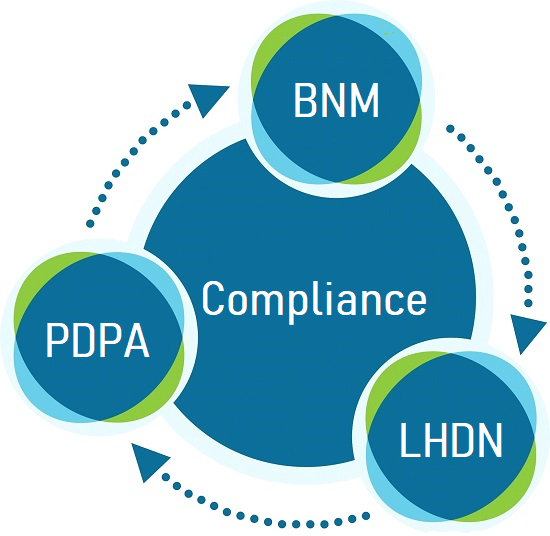
Integrating compliance into daily operations turns legal adherence into a valuable asset on the balance sheet. Here are some examples.
- PDPA Amendments: Under the updated Personal Data Protection Act, fines for breaches have increased to RM1 million. Additionally, a new 72-hour mandatory breach notification window is in effect. Adopting local cloud providers with pre-configured logging can reduce legal readiness costs by an estimated 30% annually.
- BNM RMiT Alignment: Local clouds reduce costs for financial institutions. They no longer require expensive bridge consultants to facilitate audit friction with overseas clouds. Generates savings between RM50,000 to RM150,000 per audit cycle.
- LHDN MyInvois: Mandatory E-Invoicing is now live. By implementing localized cloud ERP systems, companies avoid potential tax deduction disallowances caused by failed integration with the Government Gateway API.
| Compliance Driver | Public Cloud Risk (Offshore) | Local Private Cloud Hedge |
| Data Residency | Subject to foreign laws (e.g., US CLOUD Act). | 100% governed by Malaysian law. |
| Legal Discovery | High cost of cross-border legal counsel. | Standard local legal procedures. |
| Cyber Insurance | Higher premiums due to “complex” architecture. | 15%-20% lower premiums for sovereign data. |
Hyperscaler Exit Strategy Checklist for CFO
What a good Hyperscaler Exit Strategy looks like?
There’s no one-size-fits-all approach to a hyperscaler exit strategy. A complete migration away from public cloud computing is not necessary. Look at all your options: on-prem, co-location, bare metal or hybrid environments. What are the combinations that able to deliver the performance, cost control and flexibility that you need?
Financial planning is where a lot of businesses get caught off guard. A full hyperscaler exit strategy isn’t just about new cloud infrastructure. Service duplication during cutover is the most important. You will likely run two environments in parallel for a while. It is important to budget for that up-front.
The earlier you plan, the more flexibility you have. Not when costs explode. Not when your platform is already too complex to unwind. Therefore, having a hyperscaler exit strategy in place safeguard against unforeseen events, like regulatory changes, continuous outages, or sudden cost increases. It gives you greater negotiating power. Avoiding vendor lock-in by preventing dependency on a single public cloud provider.