

Physical and Virtual Infrastructure Migration for Tier-3 Carrier Neutral Data Centre Operator
Migrating critical enterprise business systems requires a flawless execution strategy. This case study details our comprehensive approach to physical and virtual infrastructure migration, outlining how we successfully completed Data Centre Relocation and Infrastructure Migration of a leading Malaysian data provider into a state-of-the-art facility.
Discover the strategic planning, risk mitigation, and technical execution frameworks used to guarantee total data security, zero downtime, and uninterrupted business continuity throughout the transition.
About Our Client
Our client is a premier carrier-neutral data centre operator in Malaysia, serving as a vital backbone for the region’s digital economy. They provide mission-critical co-location, cross-connect infrastructure, and hybrid cloud hosting services.
The client’s ecosystem supports highly sensitive operations, including:
Challenge: Scalability vs. Zero-Downtime Demands
As enterprise demand for high-density computing, AI-ready infrastructure, and enhanced connectivity rapidly expanded across Southeast Asia, our client outgrew their legacy framework. They required a total relocation and consolidation of their physical hardware and virtual environments into a modern, state-of-the-art facility.
However, the relocation project faced severe, high-stakes technical bottlenecks:
The Zero-Downtime Mandate
Due to the critical nature of high-frequency trading and core telecom routing, a single minute of unexpected downtime during the physical move could trigger millions of dollars in losses and violate strict Service Level Agreements (SLAs).
Complex Network Interdependencies
The legacy environment featured intricate physical fibre cross-connects and complex virtual local area network (VLAN) topologies that could not simply be unplugged without breaking critical customer links. Deploying a specialized Professional Data Centre Relocation Service was non-negotiable to handle these fragile infrastructure interdependencies.
Strict Regulatory Compliance
As a Tier-3 operator servicing the financial sector, the entire facility relocation required a completely transparent, documented process to satisfy strict central bank and government data security regulations.
Solution: Structured Migration Framework
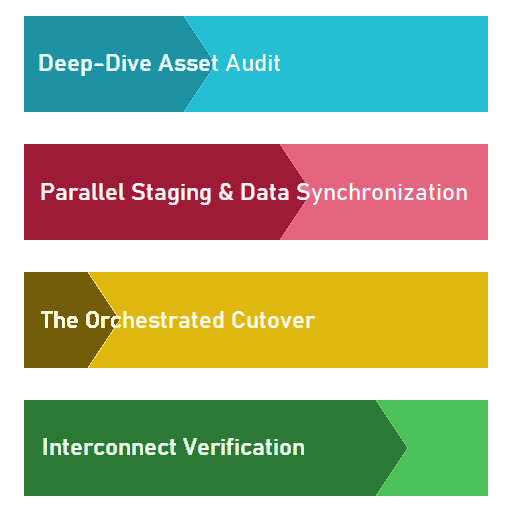
To address these challenges, our enterprise cloud and infrastructure architects deployed a proprietary Structured Migration Framework.
This strategy shifted the project from a risky “lift-and-shift” operation to a highly calculated, phased transition.
Phase 1: Deep-Dive Asset Audit
Before beginning the physical relocation of a single piece of hardware, we initiated a comprehensive discovery phase.
Phase 2: Parallel Staging & Data Synchronization
To eliminate data loss risks, we avoided a direct cold-cut relocation in favor of a live, dual-environment strategy.
Phase 3: The Orchestrated Cutover
The final transition was managed using a minute-by-minute execution playbook.
Phase 4: Interconnect Verification
Post-migration security and performance testing were conducted immediately following hardware integration at the new facility.
Technologies and Tools Deployed
Executing a high-availability infrastructure transition required a highly resilient, enterprise-grade technology stack. Our Professional Data Centre Relocation engineering team deployed advanced automation, replication, and telemetry tools to maintain continuous data synchronization and monitor system performance in real time:
Outcome and Result
The infrastructure migration and facility relocation campaign achieved all target milestones without a single operational hitch, setting a new benchmark for corporate facility transitions in Malaysia.
100% Business Continuity
Real-time hosting, core telecommunications switching, and financial exchange services remained fully online. All critical client SLAs were successfully maintained throughout the multi-week transition.
20% Improvement in Operational Efficiency
Consolidation of legacy hardware into modern, high-density configurations resulted in a 20% optimization in physical rack-space and vastly improved thermal (cooling) efficiency, lowering long-term Power Usage Effectiveness (PUE).
Audit-Ready Regulatory Compliance
The structured documentation and step-by-step logging provided an airtight audit trail, allowing the client to smoothly pass post-relocation evaluations by financial and government sector regulators.
Long-Term Strategic Partnership
Following the successful move, our team was retained to architect the client’s next-generation Disaster Recovery (DR) frameworks and future infrastructure scaling roadmaps.
FAQ
Frequently Asked Questions
Key Takeaways for IT Leaders
Never Skip Dependency Mapping
A successful physical and virtual infrastructure migration relies heavily on knowing how apps and hardware talk to each other. Documenting cross-connects early prevents cascading downtime during a complex relocation.
Invest in Parallel Environments
Utilizing swing equipment drastically reduces pressure during the final cutover, turning a high-risk event into a systematic execution.
Structure Content for Compliance
For Tier-3 data centres, having clear, readable documentation is just as critical as the technical move itself to satisfy enterprise clients and government regulators.
Plan Your Next Seamless Physical and Virtual Infrastructure Migration
Relocating legacy architecture or migrating workloads to a Tier-3 facility doesn’t have to put your daily operations at risk. Our proven Structured Migration Framework removes the guesswork, mapping out every complex dependency to ensure data security, strict regulatory compliance, and absolute zero downtime.
Learn how our enterprise cloud and network architects can map out a secure roadmap tailored to your specific business SLAs.